Although speculation about the origin of Tourist sapiens is still ongoing, evidence suggests that it is not a new hominid of the genus Homo, but rather an evolution of modern humans (Homo sapiens). This name reflects evolutionary continuity with the contemporary human species, despite observed differences in physical and cultural characteristics.
Excavation site in Alpe NovaExcavation site in Alpe Nova
Although no skeletal remains have been found, thanks to the arrangement of the objects found and our highly advanced 3D reconstruction systems powered by Artificial Intelligence, allow us to deduce that Tourist sapiens shares the same morphological characteristics as Homo sapiens: bipedal, plantigrade, with non-prehensile feet with first toes aligned with the others, hypercephalisation and a complete verticalization of the skull.
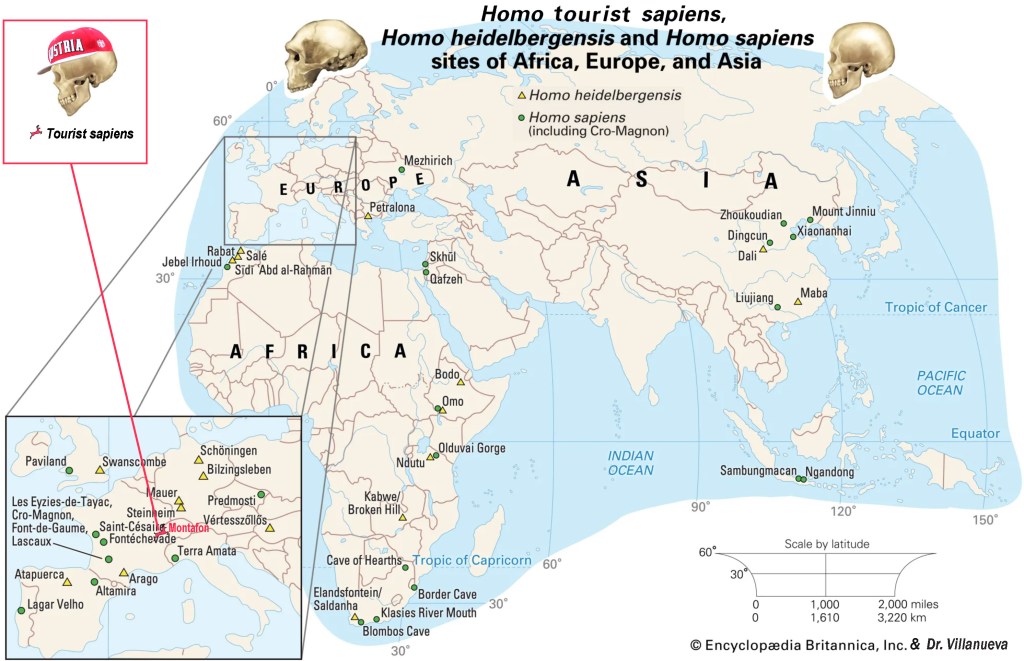
It is believed that Homo tourist sapiens montafonis, named montafonis after the place of discovery, is probably the first of many other Tourist sapiens that coexisted in this same era.
Homo sapiens is no longer alone. Until now it was considered the only non-extinct hominid species, but now, Tourist sapiens accompanies it in the evolutionary race and may change everything, since it is beginning to be speculated that many of those considered Homo sapiens were actually Tourist sapiens. It is also believed that Homo tourist sapiens montafonis, named montafonis after the place of discovery, is probably the first of many other Tourist sapiens that coexisted in this same era. It is hoped that as research progresses and further excavations are funded, more specimens of Homo tourist sapiens will be found.


 TOURIST SAPIENS