
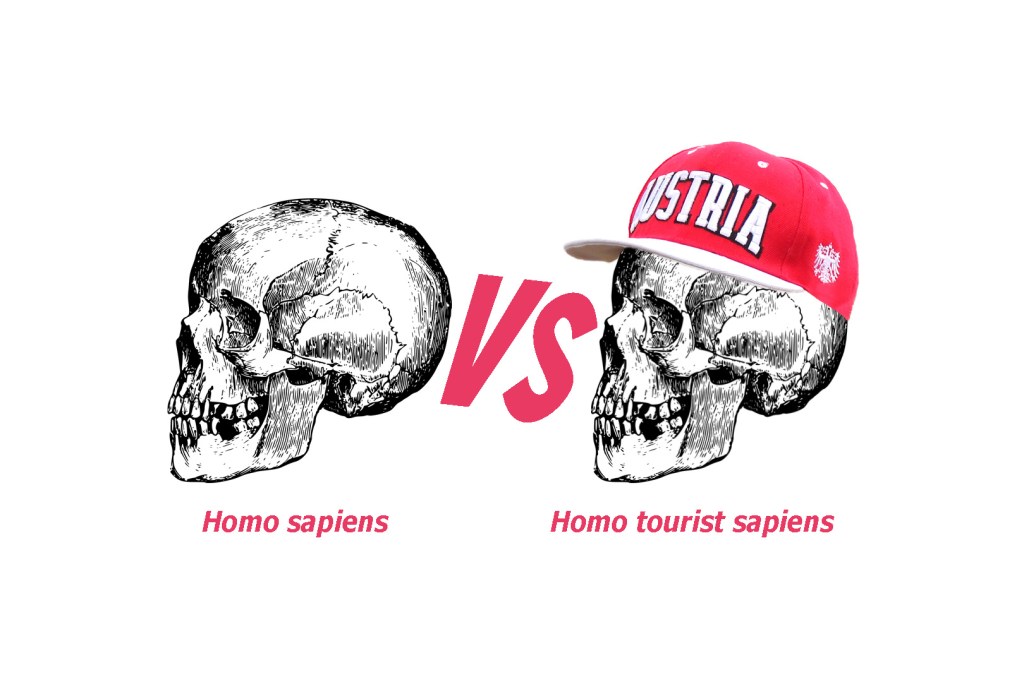
– A slightly smaller skull
Given the widespread use of technology, the Tourist sapiens brain did not have to work as hard as its predecessor’s, performing less cognitive activity. Therefore, it is believed that the skull became smaller due to a reduction in brain mass.
– A longer humerus
There are two theories why the humerus, the bone that runs from the shoulder to the elbow, is thought to be longer than usual. On the one hand, it could be to be able to climb the mountain better with or without the aid of climbing poles, such as those found in the excavation. On the other hand, it could be the use of photographic devices to take selfies. To date, there is no concrete evidence in the excavation for the second theory as no remains of photographic devices have been found. But, due to archives found in the large world library Social Media Inc. taken in the Montafon area, it leads us to speculate on this cause. Furthermore, the extensive study Behaviours and self-representation in the 21st century. An analysis of social networks before the age of Artificial Intelligence by Dr. Nir García, recommended reading, shows us numerous examples that support this theory.
– Claw-like hand bones with a hyper-developed thumb
Like the above assumptions, it is also thought that this trait could be due to prolonged use of either hiking sticks or mobile phones, or both.
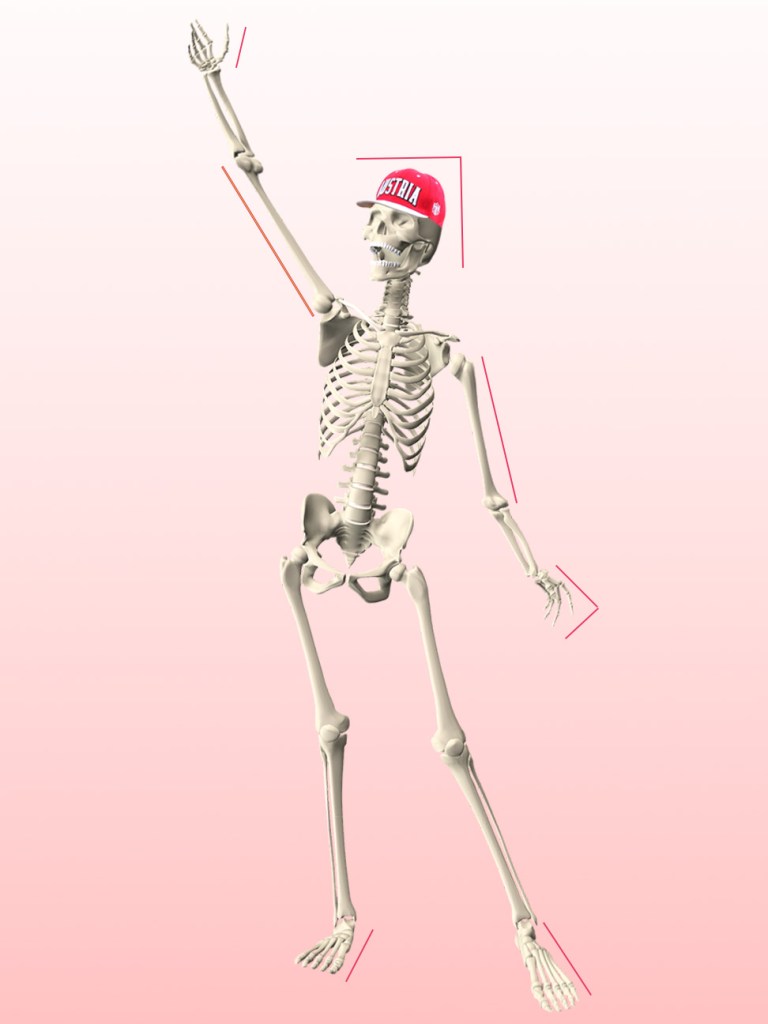
– A spine curved forward by 15°
It is suspected that Tourist Sapiens Montafonis tended to walk long hours on high altitude, steep mountain slopes. Therefore, the spine was curved to facilitate the ascent and to prevent falling backwards as a survival method. It is also thought that this curvature could be due to the abuse of cable cars to climb mountains, and that by sitting down—probably using a mobile phone—his spine would curve.
– Longer than usual calcaneal bone of the foot
It is believed that one of the main activities of Tourist sapiens Montafonis was hiking. As a result, the foot is thought to have developed in a way that increased safety and survival for this hominid.
 TOURIST SAPIENS